About Release
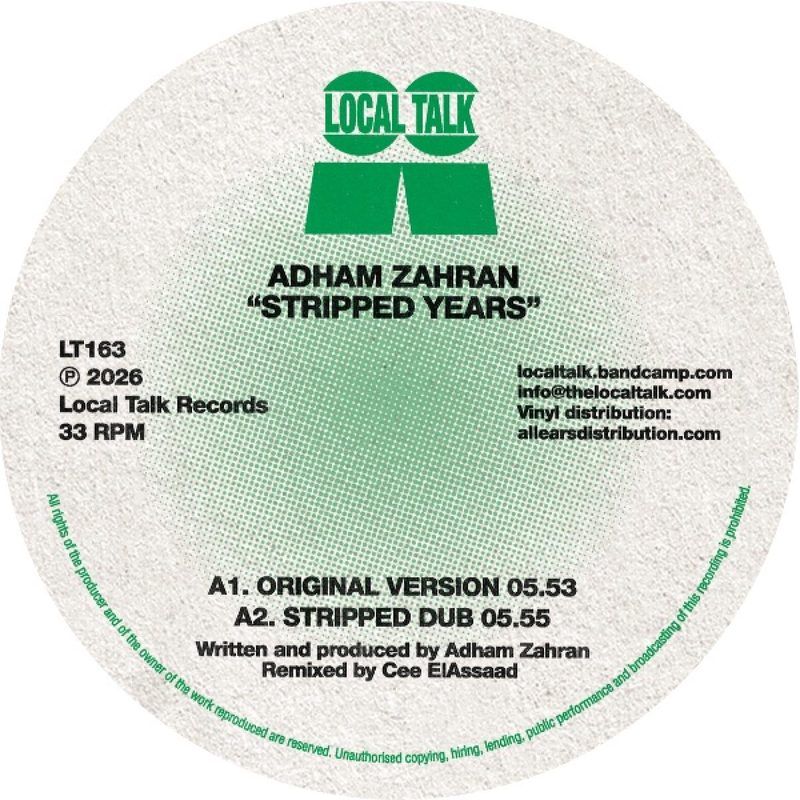
Adham Zohran makes his Local Talk debut with Stripped Years, catalogue number LT163, a four-track 12-inch that brings together deep house, soulful electronics and a distinctly North African perspective on contemporary club music. Originally issued as the producer’s introduction to the Swedish label, the release centres on the atmospheric “Stripped Years” in both original and dub forms, alongside two interpretations by Moroccan producer Cee ElAssaad. The result is a carefully balanced record that moves from deep, string-led house into Chicago-influenced territory before finally stripping the rhythm away altogether.
Local Talk places the release firmly within its long-running commitment to open-minded interpretations of four-to-the-floor music. For LT163, the label specifically highlights the growing global character of house music and uses Adham Zohran’s Egyptian background as an opportunity to explore a North African approach to electronic deep house with a strong soulful component. The label describes Zohran’s sound as sitting somewhere between the deep electronic house traditions associated with Ron Trent, Atjazz and the more electronic work of Glenn Underground.
The original “Stripped Years” establishes that identity immediately. The production is built around large, cinematic strings, exceptionally deep chords and a light but distinctly bumpy four-to-the-floor kick. The track does not attempt to create pressure through aggressive drums or an oversized bassline. Instead, its energy comes from the contrast between the gentle rhythmic pulse and the substantial harmonic material above it. Local Talk characterises it as “not hard, not pumping, just sexy and deep,” which is a particularly accurate description of the record’s understated approach.
The strings are central to the track’s emotional character. Rather than functioning as a short melodic hook, they create a broad harmonic atmosphere around the groove, giving “Stripped Years” a spacious and almost cinematic quality. The deep chords reinforce that sense of depth while the relatively light kick keeps the track moving without disturbing its relaxed character. It is house music designed around immersion rather than impact.
That balance makes “Stripped Years” particularly useful for DJs working with deep house and soulful house. The rhythm is sufficiently clear for mixing, but the arrangement leaves enough space for other records to breathe around it. The track can therefore function early in a set, during a transition toward deeper material, or as part of a more atmospheric late-night sequence. Its appeal is less about a dramatic peak than the sustained feeling created by the relationship between rhythm, harmony and space.
The second version, “Stripped Years Dub”, takes the same musical foundation and places greater emphasis on the groove. As with the classic tradition of dub-oriented house, reducing the importance of the more overt musical elements changes the role of the rhythm. The track becomes more useful as a DJ tool, with the underlying pulse and low-end character able to occupy the mix without demanding the same amount of attention as the original.
The dub treatment also highlights one of the strengths of the composition itself: the track works without needing to depend entirely on its harmonic material. The deep chords and strings provide the emotional identity of the original, but the rhythmic framework is strong enough to sustain an alternative version. For a selector, that gives LT163 two complementary ways of approaching the same production.
The B-side introduces Cee ElAssaad, the Moroccan producer chosen by Local Talk to push “Stripped Years” into another musical dimension. His remix retains the deep-house foundation but moves the track toward a more explicitly Chicago-influenced and soulful direction while keeping its electronic character intact. Local Talk describes the remix as “slightly more soulful but still very electronic and thumping.”
Cee ElAssaad’s version consequently changes the balance between the elements. Where the original is characterised by spaciousness and restraint, the remix increases the rhythmic presence and gives the track a stronger sense of propulsion. The Chicago reference is important here: the remix connects Zohran’s atmospheric deep-house approach to the rhythmic language of classic American house while maintaining the contemporary electronic production aesthetic of the original.
The result is not a radical reconstruction. Instead, Cee ElAssaad takes the central identity of “Stripped Years” and changes its physical character. The harmonic atmosphere remains important, but the groove becomes more pronounced. This makes the remix particularly effective for moving a set from deep listening territory toward a more active dancefloor environment.
The fourth track, “Stripped Years (Cee ElAssaad Beatless Mix)”, takes the opposite approach. Removing the conventional beat allows the strings, chords and atmospheric components to become the main focus. This version demonstrates that the musical material does not depend exclusively on the four-to-the-floor structure to create its emotional effect.
The beatless mix is consequently more open-ended. It can function as an intro, an interlude, a transition or simply as a listening piece away from the dancefloor. The absence of the kick changes the perception of the harmonic material: elements that might normally be experienced as part of a house arrangement become more exposed, allowing the atmospheric qualities of the composition to take centre stage.
This four-track structure gives LT163 a particularly coherent progression. The original establishes the deep and soulful foundation; the dub version makes the groove more prominent; Cee ElAssaad’s remix increases the Chicago-house influence and rhythmic energy; and the beatless version finally removes the dancefloor framework altogether. Rather than offering four unrelated interpretations, the record effectively examines how the same musical idea behaves under different rhythmic conditions.
Adham Zohran’s appearance on Local Talk is also significant within the label’s wider philosophy. Local Talk has consistently explored house music through connections between classic American traditions, contemporary European production and artists working outside the genre’s traditional geographic centres. Stripped Years fits naturally into that approach because it brings Egyptian production sensibilities into dialogue with the deep-house vocabulary developed through Chicago, Detroit and later European scenes.
The release is especially interesting from a collector’s perspective because it captures an early stage of the relationship between Adham Zohran and Local Talk. LT163 is identified by the label as his debut for the imprint, while the current Selected Wax edition is a pre-order 12-inch vinyl release scheduled for October 30, 2026. The physical format preserves the four-version structure and gives DJs access to both club-oriented and beatless interpretations on the same record.
For DJs, the record offers considerably more flexibility than a conventional two-track deep-house single. “Stripped Years” is the atmospheric centrepiece, “Stripped Years Dub” provides a more functional groove, the Cee ElAssaad remix adds additional Chicago-inspired movement, and the Beatless Mix creates a completely different tool for transitions and openings. The four versions can therefore occupy different points in a set while maintaining a clear musical relationship.
For listeners and collectors interested in deep house with a strong soulful and electronic identity, Stripped Years is a revealing example of how the genre continues to evolve beyond its original geographical boundaries. Adham Zohran’s production does not attempt to reproduce Chicago house literally; instead, it absorbs elements of that tradition and combines them with spacious electronic textures, deep chords and a North African perspective.
Adham Zohran – Stripped Years, LT163, is ultimately a release built on restraint. The original finds its power in deep chords, expansive strings and a light four-to-the-floor groove; the dub version turns that foundation into a more functional club tool; Cee ElAssaad’s remix increases the soulful and Chicago-oriented energy; and the Beatless Mix reveals the atmospheric composition underneath the rhythm. Together, the four tracks form a sophisticated deep-house record that connects North African electronic production with the international language of soulful, deep and contemporary house music.