About Release
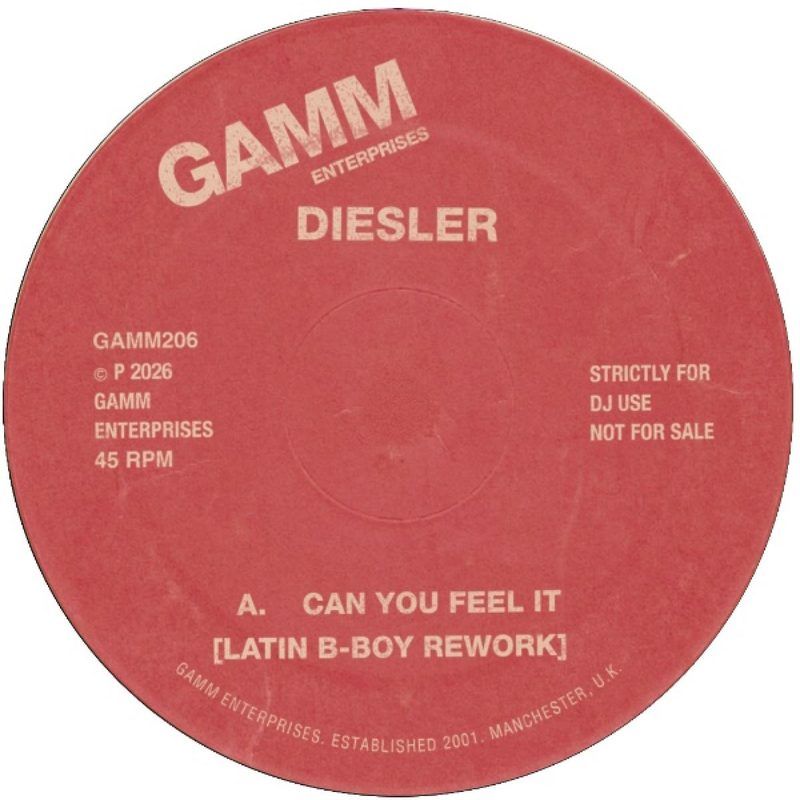
Diesler returns to vinyl with Can You Feel It, catalogue number GAMM206, a two-track 7-inch release on GAMM Recordings that transforms one of Chicago house’s most recognisable basslines into a percussive Latin and B-boy workout. Rather than presenting a conventional cover or straightforward house remake, the UK producer approaches Mr. Fingers’ “Can You Feel It” as raw material, rebuilding its familiar low-end identity around Latin rhythms, breakbeats and Chicago four-to-the-floor drums. The result is a compact but highly functional DJ record that connects classic deep house, breakbeat culture, Latin percussion and contemporary edit culture.
The story behind GAMM206 begins with one of the most recognisable pieces of electronic music ever created. Larry Heard, better known as Mr. Fingers, originally recorded “Can You Feel It” in Chicago and released it through Trax Records in 1986. The track became one of the defining early deep-house records, built from a remarkably economical combination of drum machine rhythm, synthesised bass and melodic electronics. Its influence has extended far beyond the original Chicago scene, with the record subsequently becoming one of the most frequently referenced pieces of early house music.
Diesler takes that iconic musical DNA somewhere considerably more physical. The A-side, “Latin B-Boy Rework”, combines the familiar “Can You Feel It” bassline with Latin percussion, B-boy breaks and Chicago-style 4/4 rhythm. GAMM describes the result as a serious DJ weapon, and that description is particularly appropriate: this is not an exercise in reproducing the original but a complete rhythmic recontextualisation of its most recognisable element.
The bassline remains the anchor. Heard’s original low-end figure is one of the reasons “Can You Feel It” has remained so immediately identifiable for decades, and Diesler uses that familiarity strategically. Instead of allowing the bassline to dominate the entire arrangement, he surrounds it with a much more percussive rhythmic framework. Latin drums introduce syncopation, while the B-boy breakbeat influence adds a loose, physical quality that contrasts with the strict four-to-the-floor pulse.
That combination is what makes “Latin B-Boy Rework” particularly interesting from a DJ perspective. The track sits between several traditions without needing to belong exclusively to any of them. A selector can approach it from house, breaks, funk, hip-hop, disco or Latin-oriented material, with the central bassline providing an instantly recognisable connection to Chicago house history.
The production also reflects Diesler’s wider musical background. The UK producer has spent more than two decades working across global funk, soul and underground dance music, with a catalogue that includes albums, remixes and collaborations. His recent work continues to combine organic instrumentation and rhythmic electronic production, a characteristic that makes the percussive transformation of “Can You Feel It” feel particularly natural within his catalogue.
Diesler’s history also reaches back to the early 2000s, when he released music through Tru Thoughts and became associated with the label’s fusion of electronic beats, funk, soul and jazz-influenced production. His music appeared in DJ mixes and radio programmes alongside artists from the broader broken-beat, hip-hop and electronic underground, including appearances in Solid Steel programming during the mid-2000s.
The B-side, “Latin B-Boy Dub”, takes the same central concept into a deeper direction. GAMM describes it as a highly percussive dub version intended for working the floor at a deeper level. This distinction is important: rather than simply repeating the A-side with fewer elements, the dub treatment changes the record’s function within a set. The rhythmic components become more exposed, allowing the groove and percussion to carry the track with less emphasis on the immediate impact of the main rework.
“Latin B-Boy Dub” therefore works particularly well as a transitional record. The combination of deep bass, percussion and space allows it to sit comfortably between more rhythmically dense material. The connection to Chicago house remains present through the bassline, but the arrangement is sufficiently stripped back to make the track useful when a DJ wants to lower the melodic density while retaining movement.
There is also an important historical continuity in the decision to focus on the bassline rather than attempting to reproduce every element of Mr. Fingers’ original. “Can You Feel It” has always been defined partly by its economy: the original was created from a small number of carefully chosen sounds, including synthesised bass and melody and drum-machine programming. Diesler effectively preserves that principle while changing the rhythmic environment surrounding it.
The result is therefore neither a conventional remix nor a simple edit. It is better understood as a reworking of the track’s most culturally recognisable musical component. The famous bassline provides the historical reference point; Latin percussion and B-boy breaks provide the new vocabulary; the Chicago 4/4 framework keeps the record connected to the dancefloor.
GAMM Recordings is an especially appropriate home for this release. The label has long operated within the space between funk, soul, disco, hip-hop, house and edit culture, with a catalogue that includes reworks, obscure dancefloor material and productions designed for DJs. Earlier GAMM releases have been associated with artists including Red Astaire and other producers working with raw funk and disco source material.
GAMM206 also has an interesting history before its official release. The Selected Wax listing notes that Diesler’s rework had circulated for years as a secret weapon among a small group of DJs and had never previously been publicly available. The 2026 7-inch therefore turns a previously underground DJ tool into an official physical release.
That background gives the record additional significance for collectors. This is not simply a newly produced reinterpretation of a famous house classic: it is a previously circulated Diesler rework finally receiving a dedicated commercial pressing. The 7-inch format is particularly appropriate for a record whose purpose is immediate impact. Both tracks are concise DJ tools built around a recognisable hook and a strong rhythmic identity.
For DJs, the A-side is the obvious floor weapon. “Latin B-Boy Rework” can bridge Chicago house and broken-beat material while introducing Latin percussion and a stronger hip-hop-derived rhythmic feel. Its familiarity makes it immediately effective, but the rearrangement keeps it from sounding like a routine replay of a classic.
The B-side offers the more flexible option for deeper programming. “Latin B-Boy Dub” removes some of the immediacy and puts greater emphasis on percussion and groove, allowing the record to function in a different part of a set. Played together, the two versions give the DJ both a high-impact rework and a deeper alternative without leaving the central musical idea behind.
Diesler – Can You Feel It, GAMM206, is ultimately a meeting point between generations of dance music. Larry Heard’s 1986 Chicago house classic provides the foundation, while Diesler introduces Latin percussion, B-boy breaks and a contemporary DJ-edit sensibility. The A-side turns that combination into an energetic crossover tool; the B-side explores the same material through a deeper, more percussive dub framework.
For selectors looking for unusual 7-inch material that connects classic house history with funk, breaks and global rhythmic influences, GAMM206 offers exactly that kind of crossover. It preserves the unmistakable identity of “Can You Feel It” while giving the bassline an entirely different physical environment — proving once again how effectively a familiar piece of dance music can be transformed when the rhythm around it is changed.