About Release
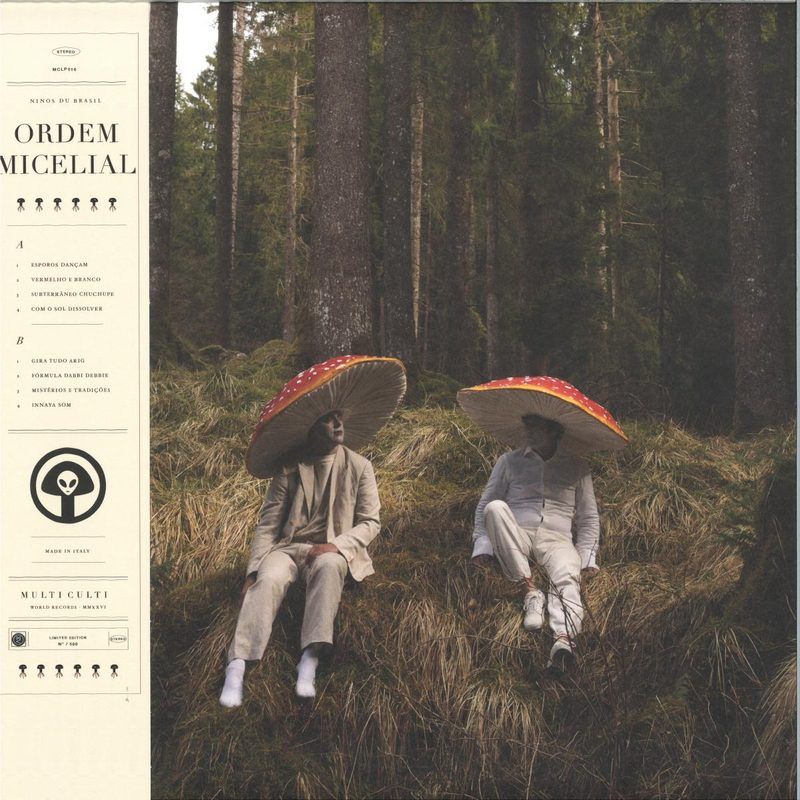
Niños du Brasil return with Ordem Micelial, their fifth full-length album and a powerful new chapter in the Italian duo’s singular fusion of batucada percussion, electronic music, punk energy and ritualistic performance. Released by Multi Culti as MCLP016 in September 2026, this eight-track 12-inch vinyl LP finds Nicolò Fortuni and contemporary artist Nico Vascellari pushing their percussion-heavy sound into darker, denser and more expansive territory. Emerging from an unusual period of interruption and creative isolation, Ordem Micelial retains everything that has made Niños du Brasil such an unmistakable underground presence while opening the project toward rock, hardcore and increasingly forceful electronic textures.
The duo’s music has always occupied an unusual space between club culture, performance art and live percussion. Niños du Brasil emerged from Italy’s underground more than a decade ago with a sound based on live batucada-style drumming, electronics, visceral voices and an imagined language, creating performances that have become known for their intensity and unpredictability. Their music connects the physical impact of carnival percussion with the repetition and propulsion of electronic dance music, while punk and hardcore provide an additional source of aggression and raw energy.
Ordem Micelial continues that approach but feels broader in scope. The album developed during the hiatus that followed their previous full-length Antro Pop, released through Codalunga / Hospital Productions in 2021. With touring interrupted during the pandemic, the duo had an extended period in which to develop new material, and that sense of transformation is reflected in an album that does not simply reproduce their established formula. The familiar frenetic drums, chants and percussive intensity remain central, but the production expands into new sonic territory.
The A-side begins with “Esporos Dançam”, setting the album in motion before moving through “Vermelho E Branco”, “Subterrâneo Chuchupe” and “Com O Sol Dissolver”. Across this first sequence, the emphasis is on the physical relationship between rhythm and sound. Niños du Brasil’s percussion is not treated as a decorative world-music element placed over electronic production; it is the structural foundation of the project. The drums create momentum, tension and density, allowing the electronics and vocals to operate as part of a much larger rhythmic organism.
“Vermelho E Branco” and “Subterrâneo Chuchupe” continue that movement through the album’s distinctive combination of ritualistic vocal expression and relentless percussion. The imagined language used by the duo is an important part of their identity: rather than functioning as conventional lyrical storytelling, the voice becomes another rhythmic and textural instrument. Chants, repetitions and vocal gestures reinforce the physical character of the drums and contribute to the hypnotic quality that connects the record with both club music and ceremonial performance.
“Com O Sol Dissolver” completes the A-side and reinforces the album’s sense of continuous motion. One of the strengths of Ordem Micelial is that its individual pieces feel less like isolated tracks and more like components of a larger environment. The combination of percussion, electronic sound design and vocal presence produces a dense sonic architecture in which rhythm remains the central organising force.
The B-side begins with “Gira Tudo Arig”, followed by “Fórmula Dabbi Debbie” and “Mistérios E Tradiçóes”. These tracks extend the album’s collision of electronic rhythm, batucada influence and underground punk attitude. Multi Culti categorises the release across House and Ritmo House, while other specialist retailers place it within a wider field of Electronica, Balearic, Rock and experimental music. That broad classification reflects the difficulty of reducing Niños du Brasil to a single genre: the music operates through rhythmic and cultural references rather than strict genre boundaries.
The final track, “Innaya Som”, provides the album’s most explicit departure from the established Niños du Brasil formula. Here, the duo move into a full guitar-driven rock assault, bringing the hardcore roots that have always existed beneath their music directly to the surface. The contrast is important because it demonstrates that the project’s relationship with electronic and carnival-derived rhythm is only one part of a much wider musical vocabulary. “Innaya Som” connects the physical aggression of live drums with distorted guitar energy, creating a conclusion that feels closer to a punk or hardcore performance than a conventional electronic track.
The production of Ordem Micelial was handled by longtime collaborator Rocco Rampino. His role is particularly important to the album’s impact: the finished record is described as a dense wall of sound, yet individual elements retain clarity and separation even at the most overwhelming moments. Live drums, electronics, voices and guitars therefore occupy distinct spaces within an intentionally powerful mix. The result is physical without becoming indistinct, allowing the record’s rhythmic detail to survive beneath its larger-scale sonic force.
This production approach also makes the vinyl format particularly appropriate. Ordem Micelial is not an album built around minimal arrangements or conventional four-to-the-floor club structures. Its appeal comes from density, percussion, texture and contrast, and the 12-inch LP presents those elements as a complete listening experience rather than a collection of isolated dancefloor tools. Multi Culti lists MCLP016 as a limited-edition 12-inch LP, while the official Niños du Brasil Bandcamp store also lists the record as a limited-edition vinyl release.
For DJs, the album sits in an especially interesting position. It can connect with sets drawing from leftfield house, tribal electronics, Balearic, experimental dance music and psychedelic club sounds, but its strongest value is arguably its ability to introduce a completely different physical vocabulary into an electronic set. The percussion has the immediacy of live performance, while the electronic framework keeps the music connected to underground club culture. It is music for selectors interested in tension, movement and atmosphere rather than conventional genre boundaries.
For collectors, MCLP016 is an important addition to the Niños du Brasil catalogue because it represents the duo’s fifth full-length and follows Antro Pop after a substantial period of creative development. The record also continues the connection between Niños du Brasil and Multi Culti, a label whose catalogue has long explored psychedelic, global, electronic and leftfield dance music. Multi Culti itself describes its musical philosophy in deliberately broad terms, positioning its releases as music for dancing, meditation, exploration and expanded listening.
Niños du Brasil – Ordem Micelial is ultimately a record about physical energy. Batucada percussion, electronics, ritualistic vocals, punk aggression and guitar-driven rock are brought together without being forced into a conventional genre framework. From “Esporos Dançam” through “Innaya Som”, the album develops a distinctive sonic mythology built around rhythm, intensity and transformation.
As Multi Culti MCLP016, Ordem Micelial captures Niños du Brasil at a point where their established language remains immediately recognisable but their musical boundaries have become wider. It is part carnival rave, part experimental electronic record and part punk confrontation: an uncompromising 12-inch LP for listeners and DJs drawn to percussion-heavy underground music, leftfield house, experimental electronica, Latin-influenced rhythms and records that refuse to stay inside a single category.